

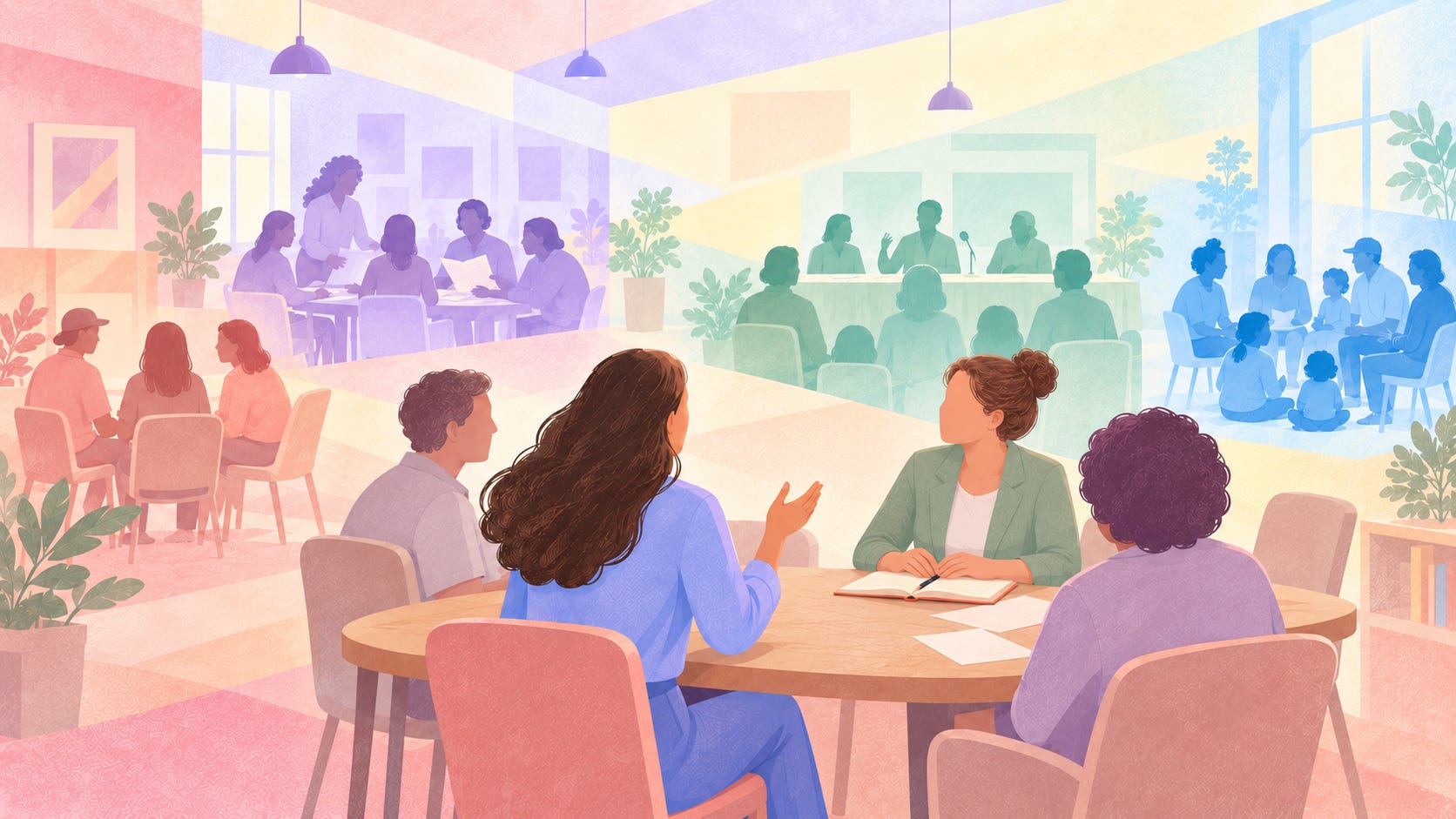
Some of the most remarkable people I know are rare disease parents and patient advocates who built something real inside their own disease communities, often out of nothing, often while living the hardest days of their lives. Many of them come to me with a version of the same question. They have given years to one disease, and they want to know how to do more with everything they have learned, how to take it wider, how to make it count beyond their own corner of the rare disease world.
I love that question, and the honest answer starts with something they do not expect to hear.
If you have spent years advocating for one rare disease, you know things most people never will. The science, the researchers and clinicians, the patient advocacy leaders, the funding gaps, the diagnostic and care challenges, the daily reality of the families living it. You can stand on a stage and teach people who are still trying to understand your community. That depth is real, and you earned it.
And here is what I learned, first by living it and then by watching it in others. That depth is not the same thing as being ready to work across the whole field. The distance between the two is worth talking about, because almost no one does.
Why I left my own disease
I did not set out to build a broader career in rare diseases. For the few years after I was thrown headfirst into the Gaucher community, my world was as narrow and as deep as it could be. I was connected to anyone in the Gaucher ecosystem that I could find, anywhere in the world, looking for anything that might save my daughter Hannah’s life. Researchers and clinicians around the world came to know Hannah and our fight, and her story reached well beyond our community, including a feature in TIME magazine and a profile in The Scientist.
What I did not expect was who I would meet along the way. Other parents fighting for their own children, some in the lysosomal world we belonged to, and others far outside it. They showed me there were children like Hannah everywhere, in diseases I had never heard of, with families carrying the same weight we were and the same fierce drive to save their children.
After we lost Hannah, those families were what turned me to start thinking outside my personal community. I could not go back to advocating for one disease alone, because I had already been so emotionally involved with so many others. That is the turning point, and I share it not because your path will look like mine, but because widening your experience almost always begins with something that makes the wider world impossible to unsee. For me, it was a loss. For you, it may be something else. Either way, the rare disease community gets bigger the moment you truly look at it.
You can’t copy and paste a community
So I went looking for that wider world on purpose. At Global Genes, I mentored hundreds of patient group leaders across a wide range of rare diseases, and a few years into my own consulting, I was advising one rare disease community after another, helping with strategic planning, building education and support programs, and strengthening how their organizations operated.
The first thing that fell apart was my assumption that I could take what worked in one community and lay it over the next. You will run into the same thing the moment you try it. It is easy to say that every disease has different symptoms, different research, and different treatments. That is the surface.
Underneath are the things you can only learn by being there: the personalities that run through a community, from the researchers to the clinicians to the families, what each group is actually fighting for, what it has to fight with, and how much weight it is already carrying. One community may pour everything into research. Another focuses on policy and legislation. Another exists to support and educate families who may never see treatment in time. None of them is cookie-cutter, because none of them is abstract. They are real patients and real families, and every one of them needs something a little different. There is no playbook.
The skill no one warns you about
There is a harder thing to learn beyond these differences. When you sit with a community that is not your own, you find its leaders are often deeply set in their direction, usually for good reason, because that conviction is what built the organization in the first place. Getting people in the same community, sometimes people on the very same board, to truly hear one another is not automatic.
Across years of rare disease consulting, and later as part-time interim executive director for two organizations that were not my own, one I helped reorganize and one I helped through its closing, the same lesson kept finding me. This is a learned skill, and my own community had never required me to learn it.
It is the work of making sure every voice in the room actually has space, and then holding all of those strong, competing ideas up to a steadier, less biased light until the community can shape something real out of them, something that actually helps the families waiting on the other side of the conversation. I am still learning it. It does not live inside any one rare disease. It only exists in the space between people who do not naturally agree, and the only way to learn it is to keep showing up in rooms that are not yours.
Your experience can’t be taught
Here is the part I most want you to hear, because it is the thing I watch advocates undervalue in themselves again and again. The experience you already carry is the most valuable thing you have, and no training program on earth can produce it. You have lived it. You know the diagnostic odyssey from the inside, the fight, the daily reality of a family holding everything together around a sick child. That is not a credential anyone can hand to you. It is the foundation on which everything else is built.
Widening your range does not replace that experience. It multiplies it. In your own community, it is why people trust you to lead and build, and stepping outside only sharpens it, because you come home able to see what your community has been missing and what it already does better than anyone else. In a community that is not your own, it lets you walk in as someone who has carried the same weight rather than as an outsider, and that is what earns real trust fast.
And yes, in the biopharma industry, it may be one of the most valuable things you can offer, because companies can hire for almost any skill, but they cannot manufacture someone who knows what families actually live through and the questions to ask to learn more about the communities outside their own they may be asked to work with. That is what you bring, and it does not expire.
So if you are asking how to do more, start here. Go find the rare disease communities that are not yours. Sit in their meetings. Volunteer for an organization whose disease looks nothing like yours. Take the role that scares you a little, the one where you do not have the answers yet. Notice what they have solved that your community is still wrestling with, and what you carry that they have never had.
Here is why this matters more than your own growth. Every rare disease community is fighting some version of the fight you know, and most of them are doing it with far less than yours ever had. The hardest-won thing you own, the experience no one can be taught, is exactly what those communities need, and right now it reaches only the people inside your own walls. What you learned was never meant to stay in one place.
This field does not need more people who are the best in one disease. It needs more people willing to carry what they know across all of them. So carry it. There are families on the other side of that choice who will never know your name and will be helped by you anyway.
First published on LinkedIn, July 7, 2026.
These views are my own, written as a rare disease parent and advocate, and do not represent any employer or organization I work with.