

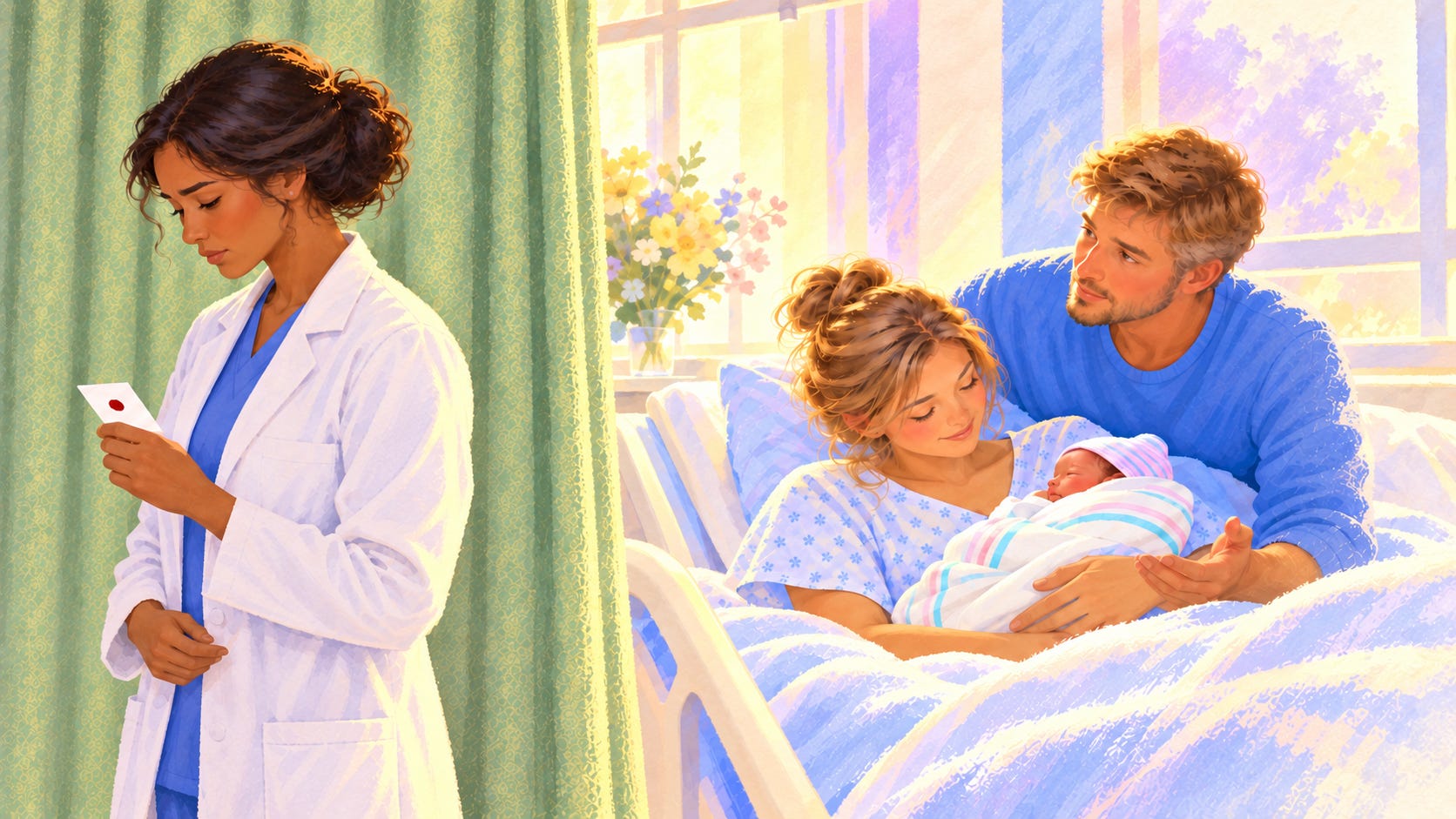
A few years after we lost Hannah, I was at a Gaucher disease conference, in a room full of clinicians, researchers, and parents who had lived what I had lived. A physician I highly respected, someone who had known Hannah herself, was on the stage talking about newborn screening and which conditions belong on the panel. At one point they said something that has stayed with me ever since. Families, they argued, do not really want to know their newborn has a life-limiting disease when there is no treatment that can change the outcome. Why hand a mother that diagnosis on the third day of her baby’s life if nothing can be done.
I disagreed, fast, out loud, in front of the room. I said that knowledge is power. I said the families I had spent years alongside, the ones raising medically complex and rare children, would have wanted to know. Not because knowing fixes anything. Because knowing lets you prepare.
I would say the same thing today. But I said it that day with more heat than the question deserved, and it has taken me years to understand why. My certainty in that room was not clarity. It was grief, the wish that someone had given us more warning than we got, dressed up as an argument about policy.
That is a real feeling, and it is not the same as seeing the question clearly. The clinician was not wrong to ask it. It is one of the hardest questions in rare disease, and it does not have one clean answer.
The case for waiting
Newborn screening was built around treatability. The whole system exists to catch the conditions we can act on, the ones where finding a baby early and starting care changes whether that child lives, walks, or thrives. That design is one of the great public health achievements of the last sixty years, and it has saved an extraordinary number of children. When a clinician asks whether a condition with no treatment belongs on that panel, they are asking a question the system was built to ask.
And the worry behind it is real. A diagnosis with no treatment behind it can take a family’s first months and turn them into a countdown. It can move a parent’s eyes off the baby in front of them and onto the loss ahead, before they have had a single ordinary day. A label can change how you see a child who still looks perfectly healthy. That clinician had watched that happen and did not want to be the reason it happened to another family. That is not a careless position. It is a protective one, and it comes from love for these families, not distance from them.
The case for knowing
Here is where I part from it. Even when there is no cure, “nothing to do” is almost never nothing. Knowing means the right specialists early instead of after a crisis, therapies and equipment and services in place before you need them, palliative and hospice support that protects a child’s comfort and a family’s time together, and parents who can make informed decisions about future pregnancies. It means an end to the diagnostic odyssey that can swallow months before anyone says the actual word.
I learned the other half of this from the inside, and from the part people do not expect. Hannah was screened at birth. Gaucher was even on the panel. Type 1, the form that can be treated, was on it. Type 2, the form Hannah had, the one with no cure, was not. The screen ran, and it did not find her, because she had the version no one had decided was worth looking for.
What came after was months without a name for what was wrong, bracing for the wrong disease, waiting on a test while the answer sat just out of reach. I do not look back on that not knowing as a kindness. It did not protect us from anything. It only took time we could have spent getting ready.
There is a quieter argument for knowing, too, and it is the one the families taught me. A diagnosis, even a hard one, connects you to other people carrying the same thing and ends the isolation of feeling like the only family on earth living it. For a lot of parents, that community is the difference between drowning and standing.
Why I still see both sides
And yet I will not pretend that clinician’s fear is nothing. I have seen what an early terminal diagnosis can do to a family’s first year, how heavy a number over the crib can become. I argued for knowing, and I would argue for it again. But I understand why a thoughtful person who loves these families could land somewhere else. This is hard, and it is hard in a different direction for every family who faces it.
The assumption underneath
So here is where I actually land, after all these years of turning it over. The problem in that room was not that the question got asked. The problem was a single word. Families.
“Families don’t want to know” decides for all of us at once. Some families want every day of warning they can get, to plan, to prepare, to hold their child with their eyes open. Some would rather not carry a diagnosis they can do nothing about. Both of those families are right, for them. The harm is not in either choice. It is in the assumption, made for families instead of with them.
And the line that assumption gets drawn on is moving. Hannah fell on one side of it, the side with no treatment behind the test. But treatments are arriving now for conditions that had nothing a decade ago, which means “no treatment” is often really “no treatment yet.” The boundary between what we screen for and what we leave off is not fixed, and a child sorted to the wrong side of it does not get those years back. That makes a blanket assumption about what families can handle more dangerous, not less.
Newborn screening is going to keep expanding, and as it does, these questions will reach more communities, including the ones who will get a diagnosis with no cure standing behind it. We are not going to settle that debate for every family, and we should not try to. The work is to make sure families are in the room when the question is asked about their child. Knowledge is power only when the person it belongs to gets to decide what to do with it.
First published on LinkedIn, September 8, 2026.
These views are my own, written as a rare disease parent and advocate, and do not represent any employer or organization I work with.