

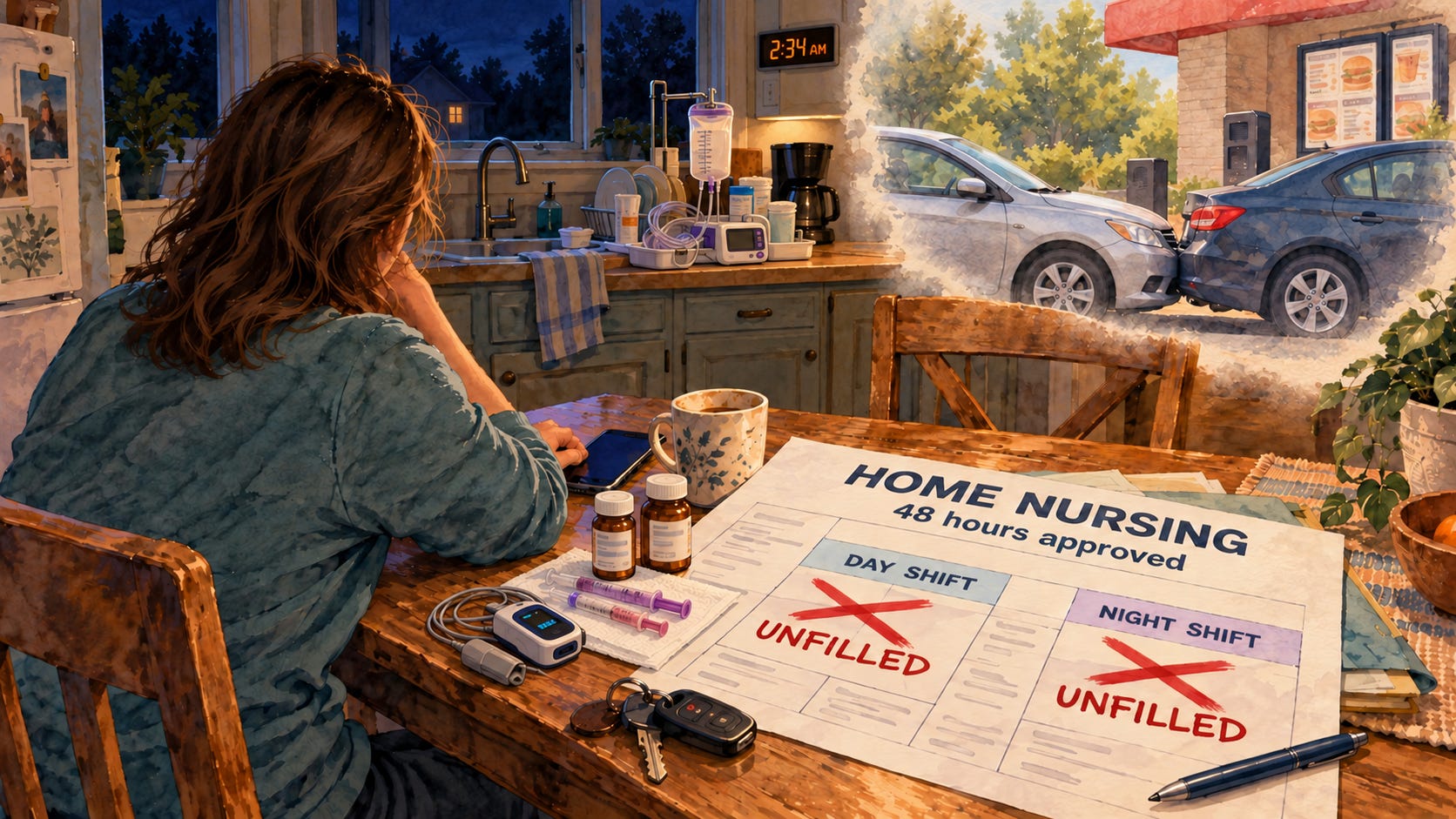
I rear-ended a car in a Jack in the Box drive-thru in Las Vegas in early 2011, right after placing my order and just three minutes from my house. My daughter Hannah was in the car with me, tucked into her car seat, and she was fine. Me? I was completely caught off guard and shocked that it happened. Looking back, I shouldn’t have been. I had been awake for more than 24 hours, and I know that’s why it happened.
On paper, we had help
Hannah had severe Gaucher disease type 2 and received an enzyme infusion every two weeks across town. The appointment took several hours, and getting her to the infusion center was part of the routine of her care. Every two weeks, we went.
I was Hannah’s primary caregiver and didn’t have a regular job outside our home because she was medically complicated. My husband, Robert, worked. His job was our family’s income and our health insurance, so missing work regularly wasn’t an option. Our older children, Ethan and Abigail, were in elementary school. Most infusion days were mine.
Hannah had a trach and a G-tube. If either came out or became clogged, she needed help immediately. Someone had to be awake and watching her around the clock, including overnight.
We had home nursing from 2010 until Hannah died in December 2011. Insurance approved 48 hours of nursing a week, usually four 12-hour shifts. We knew how fortunate we were to have that approval. On paper, we had help.
The hours that never got filled
Approved hours did not mean a nurse actually showed up for all 48 of them. We had two regular nurses who provided most of the consistency in Hannah’s care, but they couldn’t cover every approved hour. The rest depended on whether the nursing agency could find someone to fill the shifts.
Sometimes they could. Often they couldn’t. There were call-outs, open shifts and last-minute changes. I never blamed the nurses, and I knew the agency was trying to staff the hours. There simply weren’t enough nurses available within the company our insurance required us to use. But an approved hour of care and a nurse in your house turned out to be two very different things.
Our nursing schedule was a mix of days and nights. Whatever shift got filled was often when I slept. We also tried to protect time for Ethan and Abigail. We didn’t want Hannah’s care to take every available hour from them, too.
The best-case scenario was a nurse working during the day while the kids were at school. I could sleep, wake up when they got home, and be present for the afternoon and evening with them and Robert. Then I would take the overnight shift with Hannah. For more than a year, those nursing shifts were often the only predictable sleep I had.
The day before one of Hannah’s infusions, our daytime nurse called out less than an hour before her shift. That call meant the hours I had expected to sleep disappeared. I knew we had a nurse scheduled that night, so I figured I would sleep then.
The night nurse didn’t show up.
Robert handled the older kids and everything else he could while I cared for Hannah through the day, the evening and overnight. By morning, I hadn’t missed one night of sleep. I had missed both chances to sleep. And Hannah still had an infusion scheduled that she could not miss.
What the gap cost
I drove her to the appointment. Afterward, I was starving. I pulled into the Jack in the Box drive-thru near our house, placed my order and somehow rear-ended the car in front of me. We were barely moving. There was no damage to my car and very little to his. But I had hit another car with my medically fragile two-year-old sitting behind me.
Looking back, I know I shouldn’t have been driving. At the time, the practical choices I could see were to drive Hannah to the infusion exhausted or miss the infusion she was scheduled to receive. Missing it was never an option for us. So I drove. The other driver later filed an insurance claim for his barely dented bumper. Our insurance went up. And we still didn’t have any more nursing.
I think about that drive-thru whenever I hear the word “respite,” and it brings out a sarcastic chuckle. Respite often gets described as a break for an exhausted caregiver. In our house, we desperately relied on those nursing hours so that the person driving Hannah to her infusion had slept. That wasn’t a luxury. It was part of what made the rest of her care possible.
Ask how many hours were filled
If you had looked at our family on paper, we would have appeared well supported: 48 hours of home nursing every week approved by our insurance. If someone had asked me, “Do you have nursing support?” the honest answer would have been yes.
I don’t remember anyone asking the question that would have told them much more about what our lives actually looked like: How many of your approved nursing hours were actually filled last month? If a family is approved for 48 hours each week but only 24 are staffed, that family doesn’t have 48 hours of nursing support. They have 24. Someone in that house is covering the other 24. Usually that time comes from somewhere else: sleep, work, time with other children, a marriage, appointments, errands, or simply the physical limits of the people doing the caregiving.
Approval matters. But approval alone doesn’t tell us whether support actually reached the family.
So if you are an advocate, clinician, case manager or anyone else working with families who rely on home nursing, don’t stop at, “Do you have nursing?” Ask how many hours were approved. Then ask how many were actually filled.
And help the family do something to find support to make up the difference. Write the filled hours next to the approved hours in notes, care plans and reports. Take that number to the people making decisions about how home nursing is staffed and paid for.
Because what is approved on paper is not necessarily what a family is living.
Families pay for that gap with sleep, time with their other children, money and, sometimes, safety on the road. All I needed that night was enough sleep to safely drive my daughter to her infusion the next morning. That should not have depended on whether a nursing shift that was already approved happened to get filled.
First published on LinkedIn, November 10, 2026.
These views are my own, written as a rare disease parent and advocate, and do not represent any employer or organization I work with.
Carrie, Thank you for exposing the gap between care that is approved and the care that is actually delivered. I'm so sorry you lost your daughter, and sorrier still that the system set up to supposedly help you let you down so much.